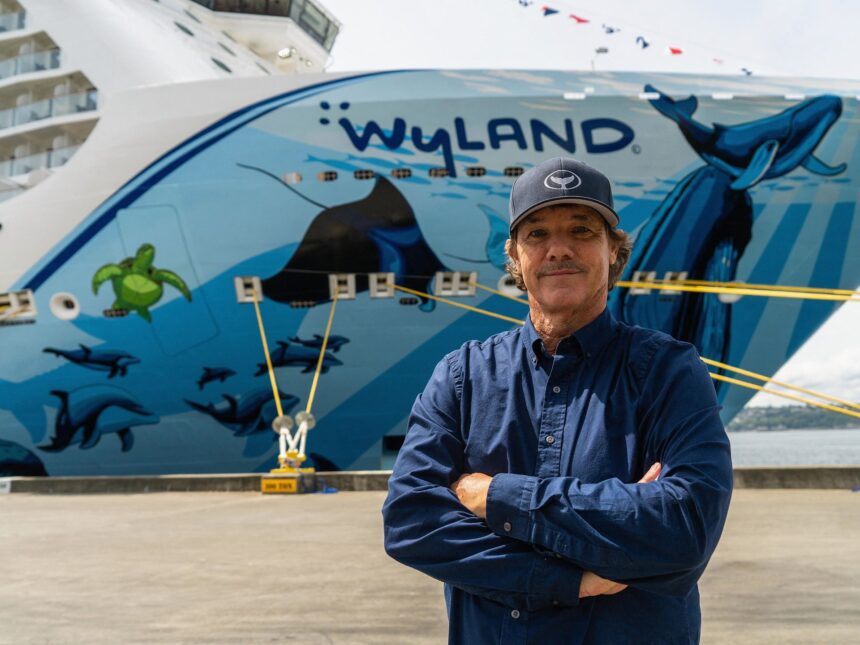

Wyland’s mural stood for nearly three decades before workers began painting it last month to promote the World Cup.
Published June 3, 2026
An American artist who painted a mural on a building in downtown Dallas featuring life-size swimming whales has filed a $25 million lawsuit against FIFA and other defendants, alleging they illegally painted over his work to promote 2026 World Cup matches in the city.
Robert Wyland, who usually uses only his last name, says he hand-painted the extensive mural that covered approximately 1,580 square meters (17,000 square feet) along two walls of a building.
Recommended stories
list of 3 itemsend of list
Wyland filed a lawsuit Monday in U.S. District Court in Dallas, alleging that World Cup organizers, the building’s owner and the management company painted over his mural without his consent or even telling him.
He said his actions violated a 1990 federal law passed to protect visual artists from the destruction of publicly displayed works.
Wyland is seeking at least $25 million in damages. Their lawsuit claims that world soccer’s governing body, FIFA, and other defendants “hastily and irrevocably destroyed a civic landmark” to promote the World Cup.
“Although FIFA claims that they were working to develop art for the host city, in truth, they defaced a historical element of the host city,” the artist’s lawsuit says.

The mural stood for nearly three decades before workers began painting it last month, causing an uproar among residents who admired the mural’s large scale and its message of ocean conservation.
The area’s World Cup organizing committee said in a statement that in place of Wyland’s mural, new artwork is planned “that captures this current historic moment and reflects the energy, unity and global spirit surrounding the 2026 World Cup.”
He said a portion of Wyland’s mural would be preserved.
A FIFA spokesman told The Associated Press news agency on Tuesday that the federation “has no involvement in this” and referred a journalist to the tournament’s local organizing committee.
A spokesperson for Slate Asset Management, which manages the building where the mural was painted, said in a statement that local World Cup organizers asked Slate in March to donate the mural space for “a new public art installation.”
“Slate does not receive any compensation for use of the wall space and was told by local groups that Mr. Wyland had been notified,” the management company spokesperson said in an email.

Dallas hosts more World Cup games than any other site in the event jointly hosted by the United States, Canada and Mexico, with nine games scheduled to be played at AT&T Stadium in suburban Arlington, home of the Dallas Cowboys.
Wyland’s Dallas mural, titled Whaling Wall 82, was completed in 1999 and is among more than 100 similar murals known as Whaling Walls that the artist painted around the world to promote the conservation of ocean life.
An online petition protesting the destruction of the mural and calling for the protection of public art in Dallas has received more than 2,600 signatures.
Wyland’s lawsuit alleges violations of the Visual Artists Rights Act, a 1990 federal law that protects works of art of “recognized stature” even if someone else owns the physical work of art.
A judge cited that law in 2018 when he ordered a property owner to pay a group of New York graffiti artists for whitewashing dozens of their spray-painted murals on buildings that once housed a factory in Queens. The ruling was upheld on appeal.