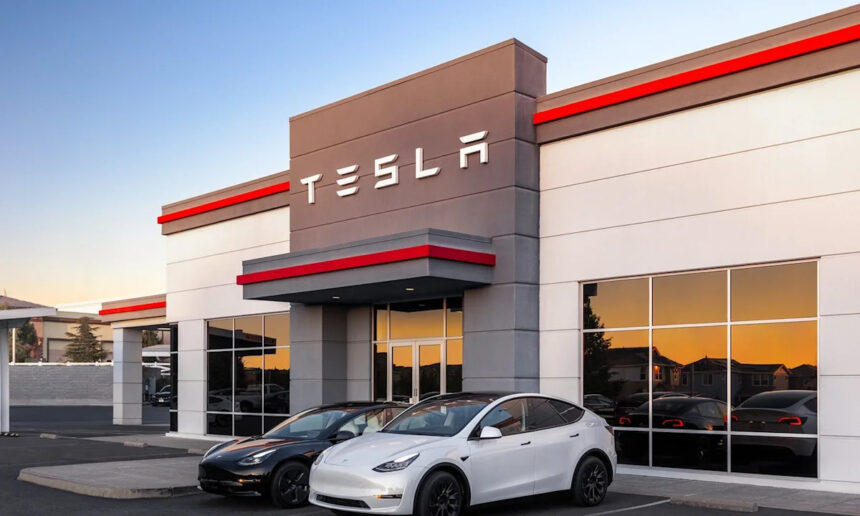
tesla (NASDAQ:TSLA) shareholders had a rough Thursday. Shares of the electric car maker sank about 15% following the company’s second-quarter report, closing at $319.69, near the end of a 52-week range from $297.82 to $498.83.
But Wall Street barely made a budget. Analysts’ average price target on the stock sits near $412 at the time of writing, about 29% above Thursday’s close. And among the 44 analysts covering the company, the consensus rating remains a Buy.
Did Nvidia miss out in 2009? This rare signal flashes again. In 2009, a “double down” signal appeared for a little-known chipmaker called Nvidia. For the first time in years, that same “Total Conviction” signal is flashing for a company that is 1/100th the size of Nvidia. Continue “
That’s a big gap. So is the decline a buying opportunity, or is Wall Street simply slow to value a story it has believed in for years?

The room behind the fall
Tesla’s revenue rose 26% year over year to $28.2 billion in the second quarter of 2026, helped by 480,126 vehicle deliveries, the best second quarter in the company’s history. This marked a 16% growth acceleration in the first quarter and led the company to surpass $100 billion in revenue in the trailing 12 months for the first time. After revenue declined last year, revenue is moving again.
The profit side is another matter. Operating income fell 57% year over year to $398 million, reducing Tesla’s operating margin to 1.4% from 4.1% a year earlier. Adjusted earnings per share were $0.33, down 18% from a year ago. For every dollar of record revenue, barely a penny made it into operating profit.
In particular, the problem was not the economics of car sales. Tesla’s automotive gross margin fell only modestly, to 16.9%.
The damage came from everything below that line, as the company spends heavily on AI (artificial intelligence), its robotaxi service and its Optimus robot program, plus stock-based compensation tied to CEO Elon Musk’s pay for 2025. Revenue from regulatory credits, which contributed to a high margin in recent quarters, also collapsed 67% to $146 million.
And for the first time in years, the quarter burned cash. Capital expenditures more than doubled to $5.8 billion, driving free cash flow to negative $1.1 billion.
In short, Tesla generated record volume and revenue in the second quarter, and almost none of it reached operating profits. That’s the quarter the market reviewed on Thursday.
What 29% of advantages are made of
Now let’s get back to that $412 average price target.
A target price is the production of a model. And the analysts behind those models, on average, still credit Tesla for a high-margin software future, a robotaxi network at scale, and strong returns on all this AI spending. The 29% gap between the target and Thursday’s close arguably measures faith in that future rather than a discount on the business Tesla runs today.