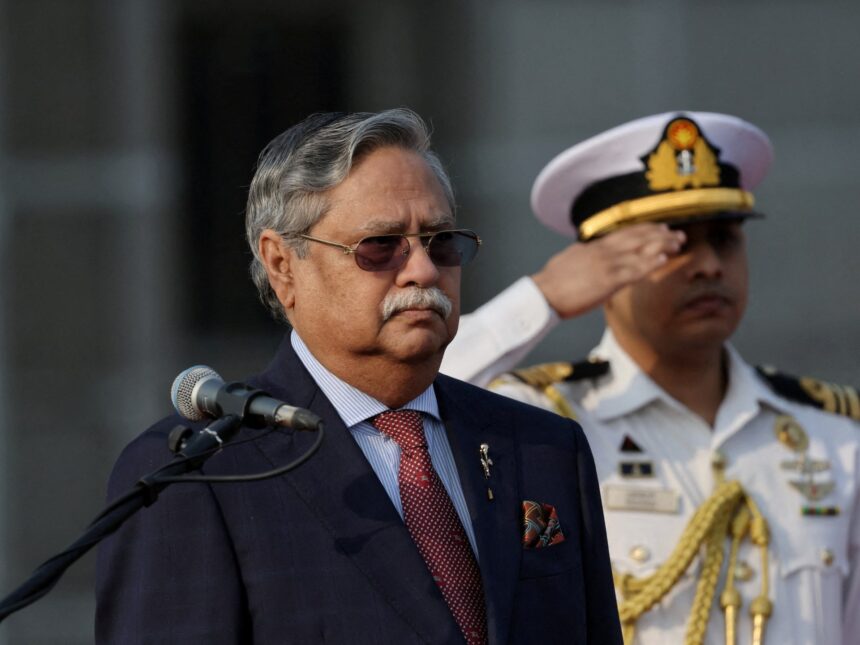
Shahabuddin, 76, cited health reasons for leaving two years before his five-year term expired.

Published on July 24, 2026
Bangladesh President Mohammed Shahabuddin resigned two years before the end of his full five-year term.
Shahabuddin, 76, cited his decision Friday for health reasons. The move comes amid growing demand from opposition parties for him to resign.
“Recent medical examinations have diagnosed me with a condition known as autonomic neuropathy. Due to this condition, I occasionally experience a momentary loss of consciousness,” Shahabuddin said in a statement released by his press secretary.
The speaker of the Jatiya Sangsad, the national parliament, will perform the duties of speaker until a new one is elected, the statement added.
According to the Constitution, a new president must be elected within the next 90 days.
“I am seriously ill… therefore, I cannot fulfill my duties as a constitutional office,” Shahabuddin said in a letter to Parliament Speaker Hafiz Uddin Ahmed on Friday.
Ahmed said he accepted his resignation, the Associated Press reported.
“Under the Constitution, the president’s resignation becomes effective upon presentation of a signed letter to the president,” said the president’s spokesman, Sarwar Alam.
The resignation comes amid media reports that Shahabuddin spoke on the phone with ousted Prime Minister Sheikh Hasina, who lives in India, during the former’s visit to the United Kingdom for medical treatment in May this year, according to Dhaka-based The Daily Star.
Shahabuddin has refuted the media report.
“I am suffering from several health complications,” he told The Daily Star when asked about the reason for his resignation. “I have nothing more to add at this time.”
He had traveled to London on May 9 and returned on May 18.
Shahabuddin has been president of the South Asian nation since April 2023. His term was due to end in 2028.
He oversaw the country during a volatile period after Hasina was overthrown in August 2024 by young protesters and until an interim government was formed days later.
Hasina is currently living in exile in the Indian capital, New Delhi, but is expected to return to Bangladesh in December, according to the Reuters news agency, which reported on Thursday on Shahabuddin’s expected resignation.
His resignation leaves Hasina without allies in senior positions five months before her planned return.
But as president of Bangladesh, his role is largely ceremonial. While head of state, executive power rests with the prime minister and the cabinet.