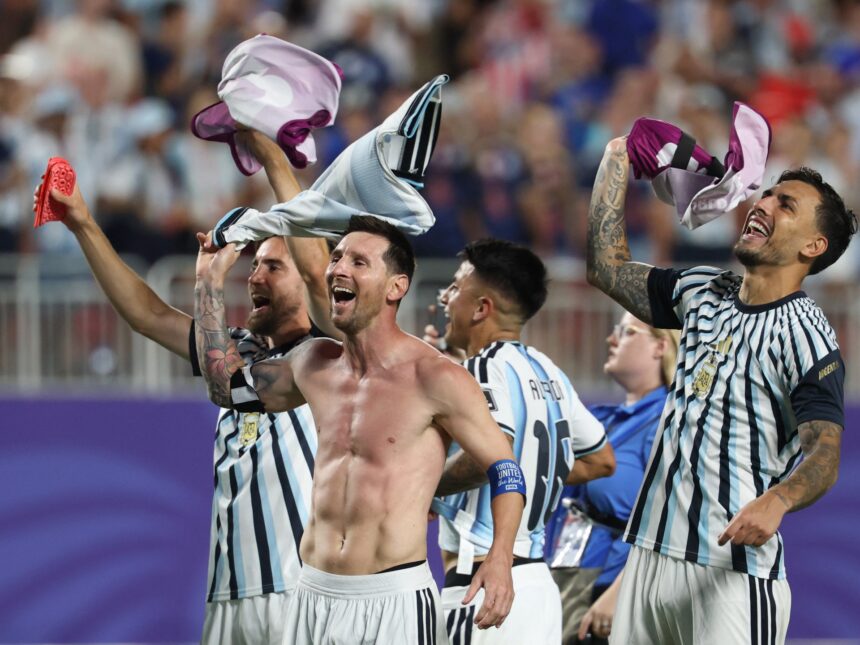
Four former champions have qualified for the semi-finals of the FIFA World Cup for the first time since 1990. Argentina, England, France and Spain capitalized on the inexperience of rivals of lesser pedigree to reach the final four.
For the Albiceleste, it was a reckless Swiss dive.
For Los Tres Leones and La Roja, the opposing goalkeepers spilled rebounds.
And Les Bleus benefited from an inexplicable, forward-less Moroccan lineup.
Here are the key takeaways from the quarterfinals:
France too good for Morocco in the 2-0 in Boston
What we learned: So far, nothing is working against France.
Morocco tried a unique approach to unsettle the French. Mohamed Ouahbi opted for a striker-less line-up which, as expected, failed to threaten.
After the match, French coach Didier Deschamps said what everyone in the room was thinking: “I was quite surprised by the starting eleven. I tried to understand why.” [Ouahbi] “I made these decisions, there was no real progress.”
Part of the reason would have been the absence of injured forward Ismael Saibari, who had a great tournament, although Morocco’s squad included three other forwards, including Soufiane Rahimi, who came on in the 60th minute. That was just after Kylian Mbappé’s right-footed shot inside the far post opened the scoring for Les Bleus.
Ouahbi’s reasoning remains a mystery.
He could have been expecting a France own goal, which was narrowly avoided when a Dayot Upamecano handle landed on the top of the net. Or perhaps the strategy of the game was for goalkeeper Yassine Bounou to continue rescuing Morocco, as he did earlier in the quarter-final tie when he saved Mbappé’s first-half penalty kick, after a VAR review of more than two minutes.

Spain scores the last goal and beats Belgium 2-1 in Los Angeles
What we learned: Pau Cubarsi is not lost.
A Barcelona teenager’s shot led to the decisive goal for Spain against Belgium, but no, it wasn’t wonderkid Lamine Yamal, who could only score a single goal in the tournament.
With the score tied and the magnificent Belgian goalkeeper Thibaut Courtois on the bench injured, Cubarsi advanced and unexpectedly shot from about 30 meters.
Substitute goalkeeper Senne Lammens might have been caught off guard: this was Cubarsi’s first attempt since the first half of Spain’s opening 0-0 draw against Cape Verde on June 15.
In any case, the shot handcuffed Lammens (in reality, Lammens handcuffed himself), leaving the rebound for Mikel Merino, who took advantage from close range to score the winning goal in the 88th minute.
So no, Cubarsi is not there to generate offense. But the fact that a 19-year-old is starting in Spain’s defense is significant. Few successful World Cup teams have opted for young centre-backs, one exception being Italian Giuseppe Bergomi, who was 18 when he played in 1982, as a substitute for the injured Fulvio Collovati.
Cubarsi struggled at times against the Belgians, but was unaffected by imposing substitute striker Romelo Lukaku. Belgium became the first team to score against La Roja in the tournament, but the key to Spain’s defense is not so much to defend, but rather to stay away Barcelona style, and that is where Cubarsi feels most comfortable.
Meanwhile, substitute striker Merino is offering almost instant attack, scoring two minutes after coming on against Belgium and five minutes against Portugal in their 1-0 round of 16 win.
What we and France also learned is that Jeremy Doku’s double team easily took down 18-year-old Yamal, meaning more of the same can be expected from Desire Doue in the semi-finals.

England beats Norway 2-1 in Miami
What we learned: Firstly, Norway still has a lot to learn. Also, don’t believe your eyes when it comes to the World Cup’s “connected” ball, whose “heartbeat” insisted that an Orjan Nyland goal kick did not hit the cable of a television camera.
During the first round, Norway coach Stale Solbakken let everyone know that his nation was not a “naive country playing for fun” when he rested everyone before a 4-1 loss to France.
The idea was to keep stars Erling Haaland and Martin Odegaard in the tournament until the knockout stages. Solbakken’s strategy worked well, until the quarterfinals, when the Norwegians were exposed.
Sure, Englishman Elliot Anderson went down as if he had received a headbutt from Zinedine Zidane around 2006. But no, it was just a push from Haaland, which caused a Norwegian goal to be disallowed, after a VAR replay. That would not be the only moment of Norwegian naivety.
At the end of the first half, a 2 on 1 ended with Alexander Sorloth failing to square Haaland and failing to beat John Stones.
Then, instead of taking advantage of stoppage time to protect a 1-0 lead, Nyland sent in a long goal kick that appeared to suddenly change trajectory and land at Anderson’s feet, prompting Solbakken’s cable television accusation to the match officials. There is nothing to see here; anyway, that’s the FIFA version. Anderson quickly found Anthony Gordon, then Jude Bellingham, and England’s equalizer occurred before half-time.
It didn’t help Norway’s defense on the flanks when Julian Ryerson went off injured. But it was necessary to wait until the third minute of extra time before Bukayo Saka earned a corner against Marcus Holmgren Pedersen. Nyland deflected Harry Kane’s chip for another corner, and there was Bellingham again, this time to convert the rebound of a Morgan Rogers shot.
Then, with Haaland on the bench, Norway had one last chance. At least, that’s what lanky Norwegian defender Kristoffer Ajer thought after England goalkeeper Jordan Pickford and a defender collided, leaving the goal open. It was not like that, the French referee Clement Turpin, who stopped the game, and reprimanded Ajer for dissenting.
Thomas Tuchel said his team was “lucky.” But evidence and experience suggest that the Three Lions are making their own luck.

Defending champions Argentina eliminate Switzerland 3-1 in Kansas City
What we learned: Don’t dive.
Switzerland appeared to have momentum against Argentina when Bree Embolo fell near the halfway line just before a snack break.
Joao Pinheiro cautioned Leandro Paredes and then changed Embolo’s yellow card sanction to simulation, after the VAR review. The official call was “mistaken identity”, and for the first time the VAR invoked a directive to intervene in the event of a “potential” red card.
Whatever the justification, the result was that Embolo, previously booked for knocking down Paredes, was sent off. Embolo’s failure seemed out of place: it was his first red card with the national team, his second at senior level and his first since a 2015-16 Europa League match against FC Basel.
We also learned that Argentina does not need Lionel Messi to score.
But it helps when Messi takes corners: he identified one for Alexis Mac Allister to head in the first goal in the 10th minute. The Albiceleste coaching staff celebrated by congratulating assistant Walter Samuel, who possibly realized that Mac Allister could find space in the middle of a Swiss team whose shortest player is four centimeters (an inch and a half) taller than him.