
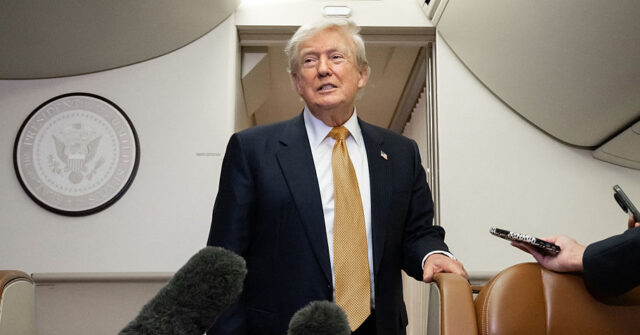
The US military is destroying large numbers of small Iranian vessels, what Tehran euphemistically calls its “mosquito fleet”, with the same missile it uses to destroy narcoterrorist ships in the Caribbean, President Trump revealed.
US President Donald Trump’s last public comments at the NATO summit that ended Wednesday night in Ankara, Turkey, were about resuming hostilities with Iran, which the president reported had cynically broken the terms of the Memorandum of Understanding and attacked civilian ships in the Strait of Hormuz. Noting that the US military was reacting by attacking what remained of Iran’s military equipment, President Trump recounted that large numbers of small Iranian attack craft were being crushed.
Iran had a certain number of conventional military assets at the beginning of Operation Epic Fury, including warships and aircraft, but these were quickly destroyed in the early days of the conflict, leaving Iran with a considerable arsenal of small, unconventional or asymmetric warfare systems. Easily hidden underground and reactivated within a short time, this has included Iran’s considerable depth of missile magazines, but also small vessels the size of speedboats.
These attack ships, known as Iran’s “mosquito fleet,” aim to wreak havoc in the Strait of Hormuz and the Persian Gulf by launching suicide bomb attacks (as manned versions of Ukraine’s unmanned one-way attack ships) or carrying Chinese-made encapsulated anti-ship missiles or laying sea mines. Otherwise unarmed, unarmed and without electronic countermeasures, they are extremely vulnerable to airstrikes and rely on their numbers for effect.
President Trump claimed that his forces had swept Iranian mosquitoes from the sea on Tuesday night and would continue to do so on Wednesday. Noting that the Iranians were “bad people” for dropping sea mines in the Gulf, the President said:
…Their entire navy is at the bottom of the sea, and now they have small ships. Little small boats. And last night we knocked out 28 of them with the same weapon we used on the drug dealers… we’re using the same thing on the mining ships, and last night we hit a lot of them…
President Trump noted that the weapons used against small boats are “the exact same missiles” as those used against drug vessels attempting to smuggle drugs into the northern United States from South America. While the president didn’t specify which missile it is, there’s a good chance it’s either the old Cold War stalwart, the AGM-114 Hellfire, or the modern budget killer, the APKWS.
Created to kill Russian tanks in Central Europe should the Cold War escalate in the 1980s, the Hellfire remains an effective air-to-ground anti-armor weapon, but both in terms of capability and cost per unit it is excessive for taking out converted speedboats.
As previously reported, the United States is now deploying the APKWS in the skies over Iran to close that gap in the cost of deaths. A guidance kit installed on a 1960s rocket (itself a derivative of a basic 1940s design), the APKWS is:
…Fast and powerful enough to easily destroy and disable small unarmored targets such as Iranian Shahed-type suicide drones and fast suicide attack boats without spending millions of dollars on prestige missiles for the job.
The APKWS is part of a broader trend in weapons design to take older, cheaper, more readily available legacy ammunition that is perfectly effective and requires no improvement in every aspect except its lack of guidance system, and modernize one. Keeping as many original weapons as possible intact significantly reduces research and development time and cost and taps into the large stockpiles of otherwise obsolete weapons that many countries still retain from the Cold War.
One such parallel development is the British Martlet light multirole missile, a missile-mounted guidance kit that traces its lineage to the portable Blowpipe surface-to-air missile of the 1960s via the Javelin and Starburst. Another is the Extended Range Joint Direct Attack Munition, a set of bolt-on gliding wings and guidance kit fitted to a Korean-era air-launched free-fall gravity bomb that directs the weapon to its intended target with a combination of inertial, GPS and laser guidance.
Russia has developed its own equivalent, adding comparatively rustic guidance and gliding kits to its own surplus of Cold War-era bombs to drop on Ukraine, adding a standoff distance of up to 60 kilometers.