
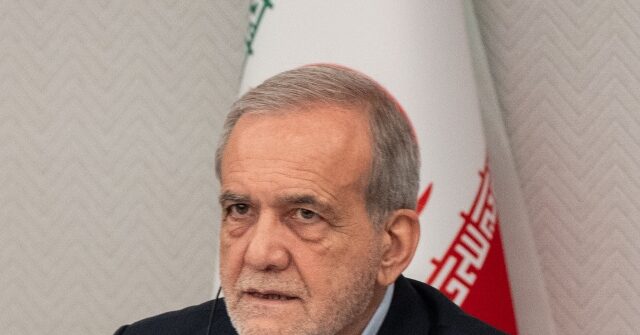
Iranian President Masoud Pezeshkian said Monday that Tehran will honor its commitments under the memorandum of understanding with the United States if Washington upholds its side of the deal, as the two sides prepared for expected high-level discussions in Doha after a weekend flare-up in the Strait of Hormuz briefly threatened the ceasefire.
“Mutual understanding is a two-way street. If the American side adheres to the agreement, we will also fulfill our commitments,” Pezeshkian wrote in
Pezeshkian’s comments came as Washington and Tehran sought to resume diplomatic contacts after a weekend flare-up briefly threatened the memorandum. President Donald Trump announced Monday that Iran had requested another meeting and said U.S. officials would travel to Doha on Tuesday.
“Iran has requested a meeting. It will take place tomorrow in Doha!” Trump wrote in Truth Social before telling reporters in the Oval Office that the discussions would be “maybe important, maybe not,” adding, “We’re going to find out.”
Trump said the administration’s goals remain unchanged despite the recent escalation in the Strait of Hormuz.
“We are winning militarily. I would say we have almost won militarily,” Trump said. “It’s really very simple. It’s the denuclearization of Iran. We don’t want them to have a nuclear weapon, and they’re not going to have a nuclear weapon. And they’ve accepted that, to be fair.”
Shortly after Trump’s announcement, White House press secretary Karoline Leavitt confirmed that special envoy Steve Witkoff and Jared Kushner will travel to Doha for what she described as “high-level” meetings, with technical discussions scheduled on the sidelines.
“Special envoy Witkoff and Jared Kushner will fly to Doha for high-level meetings this week, as we continue to discuss the memorandum of understanding,” Leavitt said on Fox News. “Aside from those high-level talks, there will be technical talks.”
Leavitt said the administration believes it has met its commitments under the ceasefire and the memorandum, while making clear that the United States would continue to respond militarily to any new Iranian attack.
“As far as we are concerned, we are delaying our part of the ceasefire. Violence will be met with violence,” he said, adding that while the United States had responded to attacks on commercial shipping in the Strait of Hormuz, “the president obviously wants to see how the peace process plays out.”
Iran, for its part, continued to maintain publicly that no direct negotiations with US officials are currently planned, despite Washington’s announcement.
The spokesperson for the Ministry of Foreign Affairs, Esmaeil Baghaei. saying A delegation of Iranian experts was due to travel to Doha to discuss implementing the provisions of the memorandum, but insisted that Tehran “has not yet entered the stage of negotiating a final agreement” and that “in the coming days, we will not have any negotiation meetings with the American side at any level.”
Iranian negotiator Kazem Gharibabadi also saying Reports that Iranian and US technical teams would meet in Doha were “not confirmed”, although they noted that consultations with Qatar on the implementation of the memorandum remain ongoing.
However, on Sunday, Trump administration officials said Washington and Tehran had agreed to withdraw following the exchange of attacks over the weekend, and another US official confirmed plans to resume discussions in Doha after both sides moved to contain the latest escalation.
The renewed diplomatic push came after an exchange of attacks over the weekend that briefly threatened the memorandum after Iran launched attacks on commercial shipping in the Strait of Hormuz, prompting two rounds of US retaliatory strikes on Iranian military targets.
Trump later warned that continued Iranian violations of the ceasefire could ultimately force the United States to “militarily complete the job” it began, warning that the Islamic Republic “will no longer exist” if Washington is able to launch a broader military campaign.
After the US attacks, Iran launched missile and drone attacks against US-linked sites in Bahrain and Kuwait, while accusing Washington of violating the memorandum.
The memorandum, signed earlier this month, established a 60-day framework to reopen the Strait of Hormuz, restore commercial shipping through the strategic waterway and begin broader negotiations on Iran’s nuclear program, sanctions relief, frozen assets and other outstanding issues.
Tuesday’s discussions are expected to focus primarily on implementing the deal, even as Washington and Tehran continue to publicly characterize the scope of the talks differently.
Joshua Klein is a reporter for Breitbart News. Email him at jklein@breitbart.com. Follow him on Twitter @JoshuaKlein.