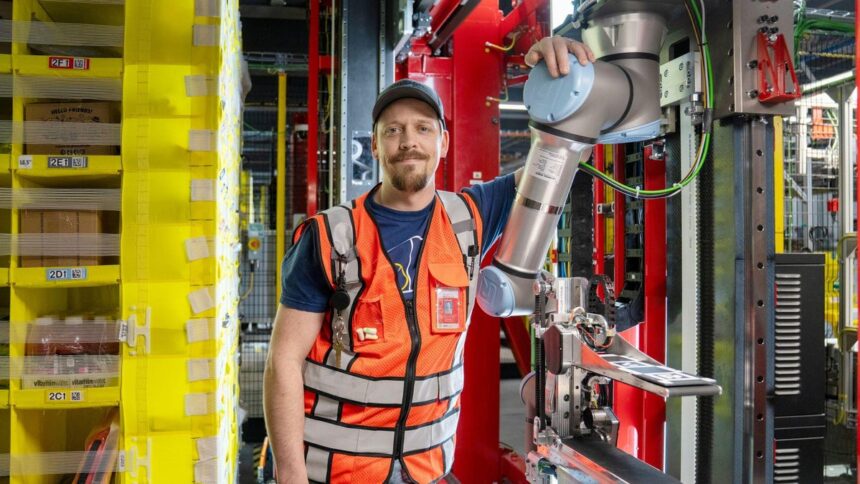
The new robot of the Amazon Vulcan Center is not no, it is not, it is not no, it is not no, it is not no, but it has some human characteristics, such as the ability to “feel” the management of the elements.
Amazon introduced Vulcan at his event by delivering the future in Germany on May 7.
“Built in key advances in robotics, engineering and physical, Vulcan is our first robot with a sense of touch,” The company said In a statement. The event is a showcase for Amazon’s technological innovations.
Vulcan can save or choose articles from the fabric pods that Amazon uses for inventory storage. He has a human, like delicacy when handling objects. Strength feedback sensors help robot to avoid damaging merchandise.
Expand image
Amazon Vulcan robot uses force feedback sensors to “feel” the objects that are collected or stored.
A suction cup and a camera system come into play when Vulcan is drawing articles from the containers.
“While the suction cup grabs it, the camera observes to make sure that it touches the right thing and only the right thing, avoding what our engineers call the risk of” coexting non -objective items, “said Amazon.
Vulcan is instead in compliance centers in Spokane, Washington and Hamburg, Germany. It is mainly responsible for reaching stored elements that require a human to be doubled or stored elements that require an employee to use a ladder.
The increase in robots in workplaces traditionally with human energy can be a sensitive issue. Amazon makes it clear that he sees Vulcan as an assistant to his employees instead of a replacement for them.
Vulcan can handle 75% of the types of articles stored in compliance centers. It is designed to know which can move and which needs to find human aid as a human robot label team.
Vulcan is part of a wave movement towards collaborative robots.
“This trend will continue since robots are often very good in some repeatable tasks, while humans are better in others,” Gartner Dwight Klappich told CNET. “I would not say that warehouses are always more efficient when humans and robots work together, is that together they are more effective.”
Expand image
The Amazon Vulcan robot can remove or save items in the batteries in a compliance center.
The robot uses a physical the AI system that includes “algorithms to identify which vulcan elements can or cannot handle, find space inside the containers, identify toothpaste tubes and paper clips boxes and much more.” The AI was trained in everything, from socks to electronics and continues to learn while the robot works.
While vulcan can be sensitive to their particular tasks, it does not reach the heights of human physical disorders.
“If you think about what would be needed to physically play a Piano Chopin concert, we are still far from this level of skill,” Klappich said.
Humans and robots can coexist in the distribution centers, they said that logistics and Koster Rene researchers from Erasmus University in the Netherlands and the Roy de Debjit of the Indian Institute of Management Ahmedabad.
“At this time, at least, the automation of the distribution center with people in the mixture is of a more efficient, flexible and profitable bet that an automated center consistent,” the team said last year in a summary of his research for Harvard Business Review.
Vulcan and his ability to “feel” his work is an evolutionary step for the robots of the realization center.
“In a nutshell, this is a notable step forward, but it is a step on a longer trip to get to where some of the chocolates,” Klappich said.
The robots have a long leg part of Amazon’s operations with more than 750,000 robots deployed in their compliance centers, the company said.
Vulcan will be implemented to more centers in Europe and the United States in the coming years, increasing the possibilities that their future Amazon shipment has the invisible “digital footprints” of Vulcan.