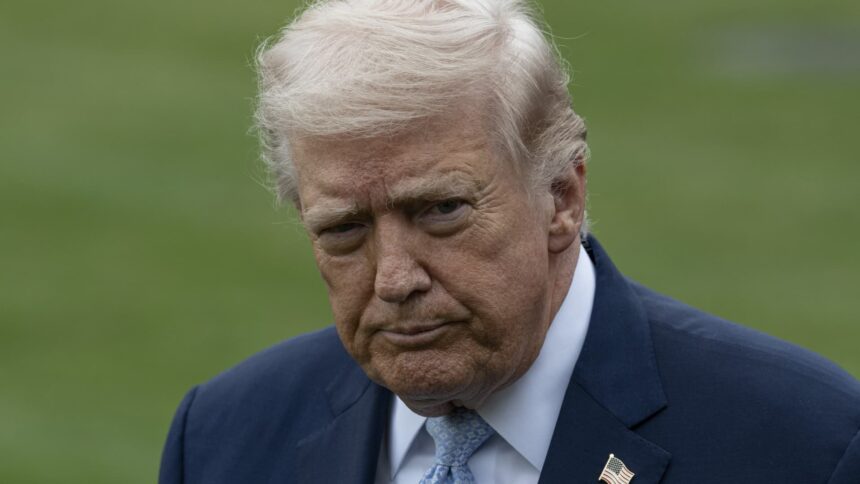
US President Donald Trump speaks to the press before departing the White House for Miami on March 20, 2026 in Washington, DC.
Celal Gunes | Anadolu | fake images
As the war in the Middle East entered its fourth week, Iran has expanded its warnings to target buyers of U.S. Treasuries, the latest salvo in an intensifying exchange of threats as the Trump administration’s 48-hour ultimatum approaches its expiration.
In a social media post on Sunday, Iranian Parliament Speaker Mohammad Bagher Ghalibaf said U.S.-linked financial institutions that hold U.S. government bonds would be attacked along with military bases.
“US Treasuries are soaked in the blood of the Iranians. Buy them and you buy an attack on their headquarters and assets,” Ghalibaf said. “Along with military bases, those financial entities that finance the US military budget are legitimate targets,” he added in the post.
The growing warning came after US President Donald Trump on Saturday issued a 48-hour ultimatum to Tehran to reopen the Strait of Hormuz, a key artery for global energy transportation, or face attacks on its power plants. The deadline will expire Monday afternoon in Washington.
Israeli Prime Minister Benjamin Netanyahu promised to back the American threat: “Whatever we do, we will do it together and, to the extent possible, with trust.”
Speaking at the scene of an Iranian missile attack in the southern city of Arad on Sunday, Netanyahu called on world leaders to join the war efforts, including European nations. “They have the ability to reach deep into Europe…they are putting everyone in their sights.”
Iran has responded, threatening to completely close the waterway and attack energy infrastructure and desalination facilities in the Gulf if the United States meets its ultimatum.
Ghalibaf warned on Sunday that any US or Israeli attack on Iran’s power plants would “immediately” trigger retaliatory attacks against energy and oil infrastructure across the region, causing “irreversible” damage.
“Critical infrastructure and energy and oil infrastructure throughout the region will be considered legitimate targets and will be irreversibly destroyed, and oil prices will continue to rise for a long time,” Ghalibaf said in X.
There is no exit ramp in sight.
Markets expected this to become a so-called “TACO trade,” referring to Trump’s history of backing down from threats to de-escalate a situation, but the president’s latest ultimatum appeared to hold firm, said Aaron Costello, Asia director at Cambridge Associates.
“The longer this goes on, the more impacts there will be,” Costello told CNBC’s “Squawk Box Asia” program on Monday, adding that the worst-case scenario would be a conflict that drags on for a month or more, to the point where supplies of raw materials and energy become critically depleted.
“Even if it concludes in a week or two, it will take time for the supply to rebalance and come back online,” Costello added.

Military hostilities continued to escalate over the weekend, with reports suggesting that Israel has been experiencing intense missile activity, prompting multiple alerts for people to take shelter in the Jerusalem and central Israel areas. According to Al Jazeera, at least eight locations, mainly in central Israel, have been hit by falling debris or explosives.
On Monday, the Israeli military said it had begun a wave of large-scale attacks on Iranian infrastructure in Tehran, with reports of explosions in several parts of the capital early Monday morning.
Iran has continued to fire missiles and drones at Israel and Gulf countries hosting American assets. Kuwait and the United Arab Emirates said Monday that their air defenses have intercepted more hostile missile and drone attacks from Iran, and air raid sirens sounded in Bahrain.
Separately, Saudi Arabia’s Defense Ministry said it had detected two ballistic missiles fired towards the Riyadh area. One was intercepted and the other fell in an uninhabited area, a ministry spokesman said.
Israeli and American attacks have killed at least 1,500 people in Iran so far, according to the Iranian Health Ministry. But the US-based human rights group HRANA, which tracks human rights violations in Iran, recorded 3,320 people killed, including 1,406 civilians and 1,167 military personnel.
Iran has effectively closed the Strait of Hormuz to most maritime traffic since the United States and Israel launched attacks on the country on February 28. The escalating conflict in the Middle East has sent oil prices soaring in recent weeks amid fears of a deepening oil supply shock, fueling inflation concerns and weighing on growth.
Crude oil prices faltered in a volatile session on Monday. Brent crude oil reversed earlier losses to gain 0.44% to $112.68 per barrel at 10:57 pm EST. US West Texas Intermediate rose 0.78% to $99 a barrel.
Tehran would rather fight a protracted war with the United States than face repeated conflicts with Israel, said Nate Swanson, director of the Iran Strategy Project at the Atlantic Council.
“They don’t need to fight a symmetrical war. They just need to survive,” Swanson said of Iran, while the United States has to decimate the regime to fully achieve its goals, he told CNBC’s Squawk Box Asia on Monday.
“Survival is victory for Iran,” he said. “They only need to attack a tanker occasionally as it passes through the Strait; they effectively have the bottleneck, even if it is not completely mined.”