US President Donald Trump is scheduled to deliver a speech at a defense summit at the US Army War College on Wednesday, where he is expected to praise US investments in its military that he says have helped add a new edge to the most powerful military in history.
But his speech comes at a time when the US war against Iran has significantly depleted the US military’s weapons arsenal.
Recommended stories
list of 4 itemsend of list
The summit, to be held in Carlisle, Pennsylvania, comes as the United States revived attacks on Iran last week and as Trump has threatened to continue a war that recent U.S. polls show is deeply unpopular among Americans facing high costs of living.
The United States has expanded half of at least four of its most critical munitions since it began its war against Iran on Feb. 28, and has racked up billions of dollars in arms spending, analyzes show.
Replenishing low stocks could take several months to several years. Analysts warn that a shrinking arsenal could put the United States in a less formidable position in a potential future conflict, particularly against China.
Here’s what we know about the US weapons inventory:

What is happening with the war between the United States and Iran?
Following a ceasefire in April between the United States and Iran, and the subsequent signing of a memorandum of understanding in June, the conflict resumed after the US Central Command launched heavy waves of attacks on Iranian military sites last Wednesday, saying they were aimed at degrading Tehran’s military capabilities. Huge hour-long attacks have continued for four nights since Sunday, including on railway tracks and bridges.
Both sides exchanged low-intensity attacks during the ceasefire period. However, the United States stepped up airstrikes last week after Iran fired on three commercial ships passing through the Strait of Hormuz, because those ships had used a sea route not approved by Tehran.
Each blames the other for violating the ceasefire, and at last week’s summit of NATO leaders, Trump declared the Iran deal over, although he said American negotiators could continue talks. Washington has also reimposed a naval blockade on Iran-linked ships attempting to transit the waterway and reimposed sanctions on Iran.
Iran’s Islamic Revolutionary Guard Corps responded with retaliatory attacks against US military assets in Bahrain, Oman, Qatar and Kuwait.
More than a dozen people have been killed in Iran since the new wave of US attacks, including civilians.
“We’re going to destroy all your power plants. We’re going to destroy all your bridges unless you come to the table and negotiate,” Trump threatened in an interview with Fox News broadcast Tuesday.
Attacking civilian infrastructure is a violation of international law.

Does the United States have enough weapons to continue attacking Iran?
Washington’s supplies are running low but have not reached a critical level, according to an analysis of the US weapons inventory by the Center for Strategic and International Studies (CSIS), a Washington-based think tank.
In the 39 days of conflict between the start of the US-Iran war in February and the ceasefire in April, the United States hit more than 13,000 targets, primarily focusing on the use of seven of its most powerful missiles and air defense systems: Tomahawk missiles, Joint Air-to-Surface Standoff Missiles (JASSM), Precision Strike Missiles (PrSM), Standard Missiles-3 (SM-3), Standard Missiles-6 (SM-6), Large Area Terminal Defenses altitude. (THAAD) and Patriots.
For at least four of the munitions, Washington likely expanded more than half of its available arsenals, although there are still many lower-quality alternatives in existence, according to CSIS. Government data on gun inventory is classified.
This is how the ammunition was used:
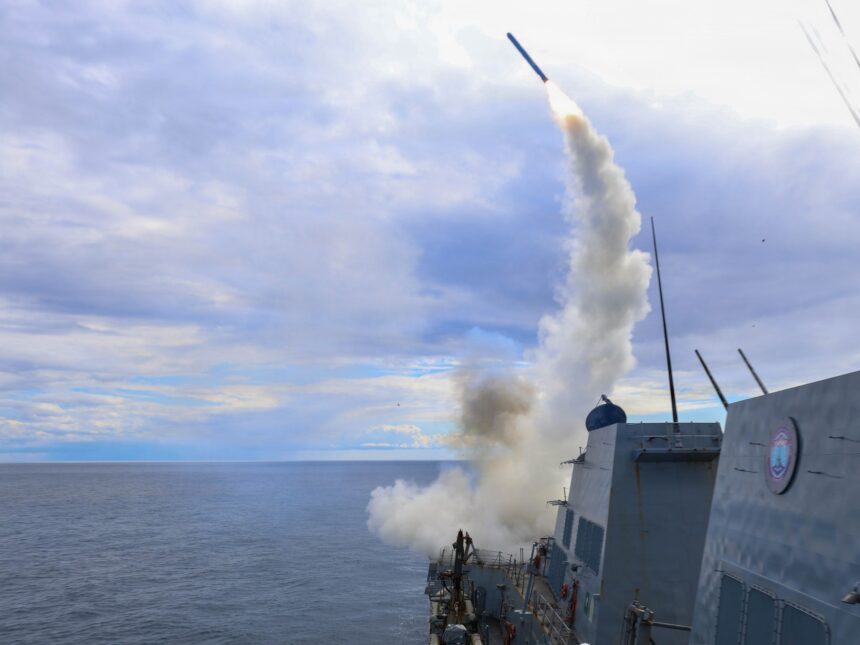
- Tomahawks – The United States had about 3,000 long-range missiles that are fired from the sea at land targets. He probably used more than 1,000 in the war against Iran.
- JASSM – About 4,000 of these long-range air-launched stealth missiles were in the United States inventory before the war. About 1,100 were used in the war against Iran.
- PrSM – For starters, supplies of the newly delivered long-range ground-launched missiles were already low: deliveries since 2023 totaled 90. An estimated 40 to 70 were used in the war. One U.S. military official claimed that “the entire” inventory had been expanded.
- SM-3- The most expensive weapon per unit, at $28 million, these ship-launched ballistic missile interceptors numbered about 410 before the war. The United States has used between 130 and 250 of these in the war against Iran.
- SM-6 – This missile, which is also launched from a ship, is primarily used to intercept aircraft and cruise missiles. The United States had about 1,160 in storage. It is estimated that between 190 and 370 have been expanded in the Iran war.
- THAAD – As of April, the United States had about 360 of these expensive anti-ballistic missile systems, and between 190 and 290 were used in the war. The United States has a total of 8 THAAD units or “batteries” composed of launchers, interceptors, and radar systems.
- Patriot – It is estimated that before the war there were 2,330 Patriots in stock, but they have expanded to between 1,060 and 1,430. There are probably some older versions available too – around 400 of them.
What does this mean?
CSIS analysts say that while the United States may have enough to continue attacking Iran in war in the near term, it has reduced its stockpile so significantly that it may not have enough for potential future wars, especially against a formidable rival like China.
Replenishing expensive, high-capacity weapons like those the United States has used on Iran will likely take several years.
Trump and senior administration officials have publicly maintained that the United States has an “unlimited” supply of weapons as the war between the United States and Iran continues.
However, in March, Trump said administration officials met with the heads of American manufacturers, including Lockheed Martin, Boeing, Raytheon, BAE Systems, Honeywell Aerospace, L3Harris Missile Solutions and Northrop Grumman. He said everyone promised to “quadruple” production and that manufacturing was already being ramped up.
Later in June, Trump signed the Defense Production Act, an executive order forcing U.S. weapons manufacturers to accelerate production, citing existing conditions “that may pose a direct threat to the national defense or its readiness programs.”
Analysts note that an order forcing private players to ramp up production would likely reflect concerns about timelines within the Pentagon.
In the short term, Washington is also unlikely to meet its allies’ demands and may not have the capacity to supply the THAADs and Patriots that Ukraine views as crucial in its war against Russia.
Orders for supplies have already hit roadblocks. The Japanese order for 400 Raytheon Tomahawks was due to be delivered between 2025 and 2027, but US Defense Secretary Pete Hegseth said in May that two more years could be added to the schedule.
Meanwhile, Switzerland began negotiations with France, Israel and South Korea in June to buy another missile defense system after its 2022 order from Lockheed Martin and Raytheon continued to face delays.
How long will it take to replenish the weapons?
Hegseth said in May that it could take “months and years” to replenish supplies, depending on the weapons system.
Analysts estimate that it could take the United States between one and four years to get its stockpile of the finest munitions back to pre-war levels with Iran, even as Trump has boasted that new weapons plants are being built across the United States and that production is increasing.
The Trump administration is set to purchase large quantities of advanced munitions in its proposed $1.5 trillion defense budget for 2027, a 44 percent increase over the 2026 defense budget.
According to CSIS, the estimated time frames to replenish the seven critical munitions, based on existing production facilities, are:
- Tomahawk: Between 4-5 years (207 will be delivered in 2026, while 785 have been requested for 2027).
- JASSM: 1 year (821 to be delivered in 2026 and 821 requested for 2027).
- PRSM: 8 months (70 to be delivered in 2026 and 1,134 requested for 2027).
- SM-3: 3 years (52 to be delivered in 2026 and 214 requested for 2027).
- SM-6: 3 years (125 to be delivered in 2026, and 540 requested for 2027).
- THAD: From 3 to 3.5 years (92 to be delivered in 2026 and 857 requested by 2027).
- Patriot: 3 years (172 to be delivered in 2026 and 3,202 requested for 2027).