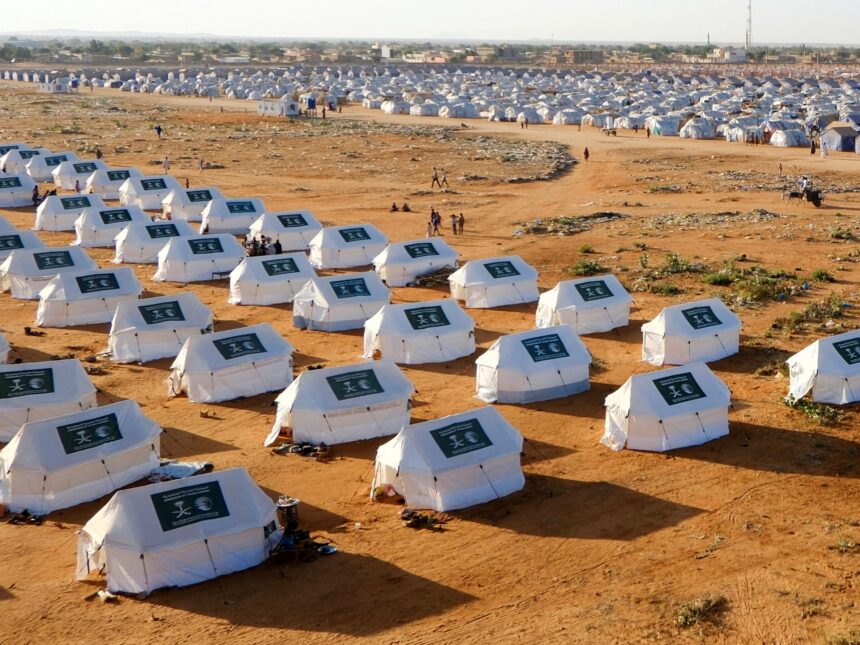
Half a million people are trapped in the Sudanese city of el-Obeid, capital of North Kordofan state, as the paramilitary group Rapid Support Forces (RSF) attempts to assert its rule over the Kordofan and Darfur regions during a civil war that has caused devastation in the country for three years.
The Office of the United Nations High Commissioner for Human Rights has warned of an imminent humanitarian “catastrophe” as El-Obeid is expected to be the next site of major ground clashes between the RSF and the Sudanese army. Many countries have also raised the alarm about the atrocities taking place in the city.
El-Obeid, which has been isolated for months by continuous drone attacks, is threatened after the mass atrocities carried out by the RSF in el-Fasher, capital of the state of North Darfur.
In October, the RSF took el-Fasher, which they had besieged for 18 months. Last week, Amnesty International said the massacres in the western city amounted to ethnic cleansing, while an independent UN mission said in February that the assault bore the “marks of genocide”.
The RSF has been gathering forces around the strategically important south-central town of el-Obeid for months, placing some 500,000 people, including 105,000 displaced people, in the middle with nowhere to flee.
The war in Sudan began in April 2023, when the RSF attacked the capital, Khartoum. It quickly spread throughout the country.
The war is considered one of the world’s worst humanitarian conflicts, with tens of thousands of deaths. It is also the largest displacement crisis in the world, with more than 14 million refugees or internally displaced people.
This is what we know:
What is happening in El-Obeid?
El-Obeid has been subject to “relentless” drone attacks by “advancing paramilitaries,” United Nations High Commissioner for Human Rights Volker Turk said on Friday.
Much of the city’s infrastructure has been damaged. Attacks on its power plant have caused blackouts, disrupted water supplies and hampered hospitals’ ability to operate. The Yale Humanitarian Research Laboratory reported that the city is experiencing an electricity and fuel crisis.
Last week, an international coalition of countries warned of imminent atrocities in the city. Norway submitted a statement on behalf of the Coalition for the Prevention of Atrocities and Justice for Sudan. The group consists of the United Kingdom, Canada, France, Germany, Ireland, the Netherlands and Sierra Leone, and they said they were joined by 21 other countries.
“We are gravely alarmed by the urgent risks of atrocities and deliberate killings in Sudan,” the statement warned.
“Ten consecutive days of drone strikes have killed at least 50 civilians in El Obeid and North Kordofan, and caused significant damage to civilian infrastructure,” the statement continued.
“Widespread, credible reports of ethnic violence, including sexual and gender-based violence, are deplorable.”
The UN has called on the international community to prevent another catastrophe in Sudan.

Why is El-Obeid strategically important?
El-Obeid lies on a key route between the RSF-controlled Darfur region and some of the eastern regions controlled by the army.
Whoever controls El-Obeid controls a key gate through which goods, people and supplies flow into central Sudan. Government forces have their 5th Infantry Division and air base there. The city is also home to an oil pipeline and a large gum arabic market.
If the city falls to the RSF, it would severely limit the army’s ability to control the Kordofan region. The RSF would also have control of a supply route connecting its western strongholds with the rest of the country.
Ahmed Ben Omer, an independent Sudanese analyst, told Al Jazeera that the possible fall of El-Obeid would trigger a strategic shift in the war: “The city lies at the heart of a network linking Darfur, Kordofan and central Sudan. Its control would give the RSF an opportunity to connect vast geographical areas and rebuild its political project after losing Khartoum.”
The RSF was explained from the national capital in March 2025.
What happened in El Fasher?
El-Fasher was the subject of a brutal massacre by invading RSF forces last year. Thousands of civilians died after the Sudanese army withdrew.
Like El-Obeid now, the city had been under RSF siege for 18 months (from May 2024 to October 2025) when its forces stormed it. During that time, Amnesty International accused RSF of crimes against humanity after survivors said civilians were subjected to sexual violence, targeted killings, torture and detention. Their access to food, water and humanitarian assistance was also cut off.
The UN had also warned of the impending humanitarian crisis in El Fasher, but the international community failed to act.
Leena Badri, a non-resident fellow at the Tahrir Institute for Middle East Policy, said there are some important differences between el-Obeid and el-Fasher that indicate how the war is evolving militarily.
“El Fasher suffered a complete and prolonged siege,” he said. “El-Obeid is really an example of the widespread use of drones, and how the use of drones essentially creates the conditions of a siege without them having to completely surround the city.”
However, the end result – famine – will likely be the same for the people trapped in El-Obeid, Omer said. “A siege has a clear purpose: to exhaust the population, increase the cost of living, disrupt markets, restrict the movement of goods, and gradually empty the city from within.”
He noted that in el-Fasher, the city fought a military battle “as its residents fought a daily battle for food, water and medicine” and warned that prolonged pressure on el-Obeid could lead to famine, which was confirmed in el-Fasher in September.
What are the current conditions like in El-Obeid?
Badri said residents of El-Obeid are in extremely dire circumstances, as drone attacks on infrastructure and water supplies have forced residents to resort to wells and water tanks outside the city.
“Food prices have increased by up to 300 percent and water prices have doubled. Access to aid has also been reduced due to the security situation,” he said.
Turk, the U.N. rights chief, told the U.N. Human Rights Council last week: “Civilians have been subjected to siege-like conditions for 18 months, hit by relentless drone strikes, as the Sudanese armed forces and Rapid Support Forces fight for control of areas surrounding the city.”
Omer told Al Jazeera that stopping a potential catastrophe is a matter of political will and influence of international actors.
“The United States has sanctions and tools of financial pressure. Egypt has direct political and security weight in the Sudan file,” he said. “Saudi Arabia has important diplomatic and regional influence and hosted the Jeddah process. The UN Security Council has legal and political tools.”
The Jeddah process refers to talks held shortly after the war began. They resulted in an agreement aimed at ending the war in May 2023, but fighting resumed a day after it took effect.