Abolhassan Montazer and Vahid Baniamerian have been hanged after Iran’s Supreme Court confirmed their sentences.
Published April 4, 2026
Iran has executed two men convicted of being members of the banned opposition group People’s Mojahedin Organization of Iran (PMOI/MEK), in the latest action targeting dissidents even as the US-Israel war against Iran drags on.
The two were executed on Saturday morning after the country’s Supreme Court upheld earlier rulings convicting them of membership in the PMOI/MEK and for “armed rebellion through participation in multiple terrorist acts.”
Recommended stories
list of 4 itemsend of list
“Abolhassan Montazer and Vahid Baniamerian… were hanged after the trial and their sentences were confirmed by the Supreme Court,” the Iranian judicial website, Mizan Online, said on Saturday.
The PMOI/MEK had initially supported the 1979 Islamic revolution that overthrew the Iranian monarchy. However, in the 1980s, it fell out with the new leaders in Tehran and was designated a “terrorist” organization. Since then, the PMOI/MEK has operated in exile.
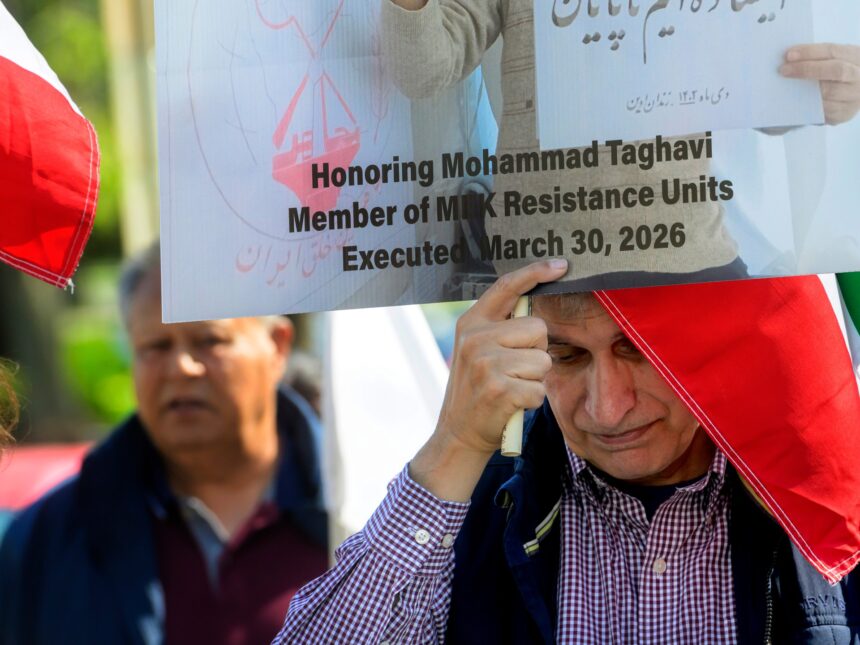
Four other convicted members of the group were executed on March 30 and 31. According to information on the WIPO/MEK website, the men were: Mohammad Taghavi, Akbar Daneshvarkar, Babak Alipour and Pouya Ghobadi.
The six men were arrested and sentenced by a Revolutionary Court in late 2024, according to PMOI/MEK.
‘Useless’ repression
The group condemned the executions in an April 2 statement, calling Tehran’s actions a “futile” attempt to suppress the opposition.
“These brutal executions will not silence the opposition; on the contrary, they will only intensify the determination of Iran’s rebellious youth to overthrow the regime,” the PMOI/MEK said.
Human rights groups have also criticized the hanging space. Activists have long accused Iran of being the second most prolific executioner after China.
In a statement following the first series of hangings on March 31, Amnesty International accused Iranian authorities of torturing the men while they were detained in prison and then abruptly moving them to an unknown location shortly before their executions.
Amnesty also raised fears of more planned executions, including those of protesters arrested during mass anti-government demonstrations in January, during which thousands of people were killed.
“It is unacceptable that, even as the population is recovering from conflict and mass mourning amid ongoing aerial bombardments by Israel and the United States, authorities in the Islamic Republic of Iran continue to use the death penalty as a weapon to eradicate dissenting voices and further terrorize people,” said Diana Eltahawy, Amnesty International’s deputy regional director for the Middle East and North Africa.
Since the US-Israel war against Iran began on February 28, Tehran has executed several people, including Kouroush Keyvani, a dual Iranian-Swedish national convicted on charges of spying for Israel in a case that has sparked outrage in Stockholm and the European Union.
Also executed on Thursday was a man convicted of acting on behalf of Israel and the United States during the protests.
Previously, on March 19, four people (Saleh Mohammadi, Mehdi Ghasemi and Saeed Davoudi) arrested in connection with the uprising were killed.
Amnesty warns that five more young protesters previously sentenced to death could soon be executed after they were moved this week from Ghezel Hesar prison to an unidentified location.