
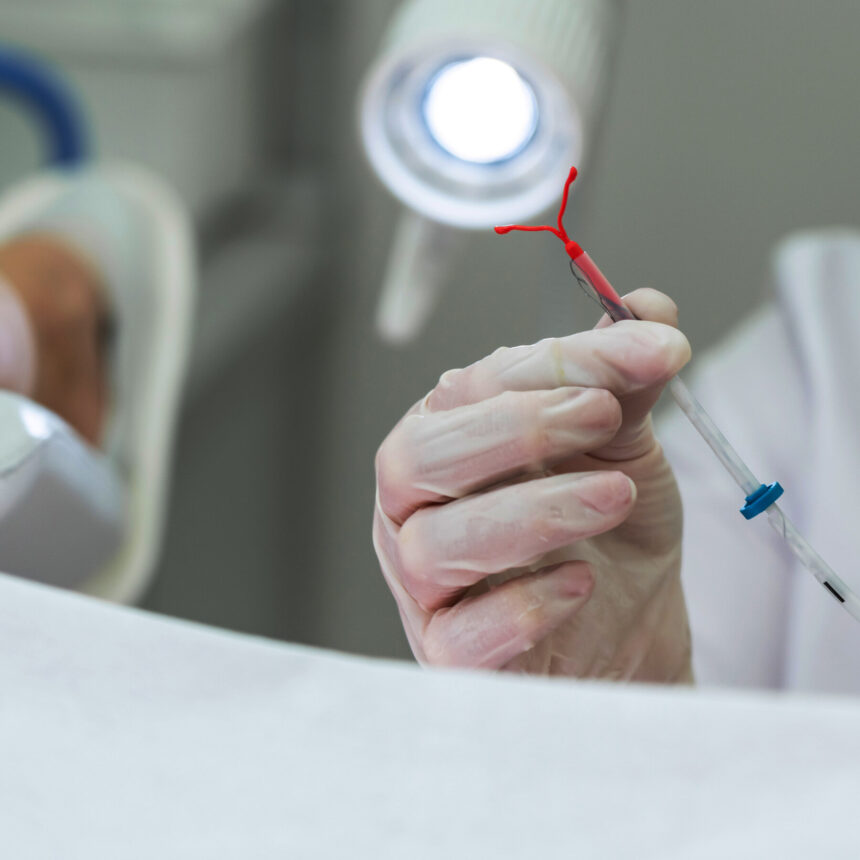
The Centers for Disease Control and Prevention recently issued new guidance on managing pain during IUD insertion, but doctors say the updated advice — while a step in the right direction — doesn’t tackle all of the sources of discomfort during the procedure.
IUDs, or intrauterine devices, are an increasingly popular form of long-term birth control in the United States.
The insertion of an IUD — a small T-shaped device that is placed in the uterus — can be painful. As TikTok has grown in popularity, so too have videos of people detailing their experiences of getting an IUD, describing cramps, bleeding and passing out, sometimes even making videos in the exam room.
The CDC’s new guidance, published earlier this month, includes a new recommendation: patients should be counseled on pain management before the procedure.
Because they are more than 99% effective in preventing pregnancy, the challenge for doctors is helping individuals who want an IUD to manage the pain, said Dr. Deborah Bartz, an OB-GYN at Brigham and Women’s Hospital in Boston.
“A lot of us have recognized that historically, women’s pain has not been adequately addressed, that we’re trying to be much more cognizant of pain that patients feel during procedures,” Bartz said.
The updated guidelines also expand options for pain management for the first time since 2016. That year, the agency recommended as an option a lidocaine injection into the cervix as an option to numb the area and reduce pain. This latest update expanded that to include topical lidocaine, in the form of gels or sprays.
This, however, only targets a part of the pain felt during an IUD procedure.
Why are IUD insertions painful, and what can help?
IUD insertions begin with a pelvic exam, after which the health care provider accesses the cervix using a speculum, the same tool used in pap smears. Next, a tool called a tenaculum is used to hold the cervix in place while the provider measures the depth of the uterus and then inserts the IUD.
The insertion process itself usually takes under three minutes.
Depending on the person, pain is felt differently throughout the procedure, but doctors say that measuring the depth of the uterus and inserting the IUD often causes an intense cramp.
However, much of the scrutiny — and solutions — focus on the tenaculum, the medieval-looking device with two hooked ends that holds the nerve-heavy cervix in place as the uterus is measured and the IUD is inserted.
Bartz said this portion of the procedure can cause discomfort, but it’s usually not the most painful part.
Swiss medical device company Aspivix has developed a new tool, called the Carevix, intended to replace the tenaculum and cause less pain. It was cleared by the Food and Drug Administration in early 2023 and uses a suction method to grasp the cervix instead of pincer-like forceps.
Results from a study conducted in Switzerland run by the company suggested the Carevix may decrease pain and bleeding for some patients, and another clinical trial is currently underway in the U.S., led by researchers at Indiana University.
Aspivix already has a warehouse and manufacturing plan ready for a commercial rollout before the end of 2024, said Ikram Guerd, the company’s U.S. managing director. Right now, it’s partnered with about a dozen clinics, mostly private and university hospitals, to “soft-launch” its product.
Dr. Beverly Gray, an OB-GYN at Duke Health in Durham, North Carolina, said she’s curious to try any new device, as long as it’s as effective as the current tools. But she cautioned that no current solution will erase pain for all patients.
Even lidocaine, as recommended in the CDC guidelines to ease pain, has limits.
“The numbing or the anesthetic medication is not like a silver bullet,” Gray said. “It is not something that universally helps everyone’s pain experience.”
Bartz said that lidocaine injections can be painful and noted that, in her experience, local anesthetic really only helps with tenaculum-related pain. Evidence is ambiguous on whether lidocaine injections or gels relieve cramps from placement itself.
Doctors say they’re working from a limited toolbox.
Currently, the only options to target placement cramps are through nonsteroidal anti-inflammatory drugs like ibuprofen or conscious sedation, neither of which the CDC included in its recommendations.
“The standard for me is to recommend ibuprofen, which was not discussed in the CDC guidelines, 600 or 800 milligrams — sort of a whopping dose at least a half hour prior to the procedure is most apt to help with cramping,” said Dr. Susan Reed, a gynecologist at UW Medicine in Seattle.
When doctors do recommend ibuprofen before the procedure, some women may think their concerns aren’t being taken seriously.
Alessa Rodriguez, 37, held off on getting an IUD for three years because of the pain. Part of that process, she said, involved finding a gynecologist who was willing to answer her questions and validate her decision.
“I remember I had a long piece of paper of just question after question — trying to understand what exactly is the kind of pain I’m feeling?” Rodriguez, of New York City, said. “I understand that it’s different for everybody, but I didn’t want somebody to just say, take ibuprofen.”
In underserved areas where contraceptive care is scarce, available options to manage pain may be fewer.
“Definitely higher resourced settings are more equipped,” said Dr. Kerry Caputo, a complex family planning fellow at Northwestern University’s Feinberg School of Medicine.
‘A lack of good options’
The CDC guidelines rely on existing research, which often isn’t there yet for contraceptive pain.
“That’s the million-dollar question to me,” Reed said. “Do we do enough research in women’s health in general? The answer is absolutely not.”
Updating the guidelines is a multiyear process. Dr. Antoinette Nguyen, a medical officer in the CDC’s Division of Reproductive Health, said the group constantly monitors new research, then determines what is significant enough to issue a recommendation.
Amid a lack of research, Dr. Aaron Lazorwitz, a complex family planning specialist and professor at the Yale School of Medicine, said gynecologists feel like they’re missing a piece of a puzzle.
“It’s been very frustrating in our field, the lack of good options,” Lazorwitz said. “We’re trying to find new tools that we can use because right now the tools are just not adequate enough.”